
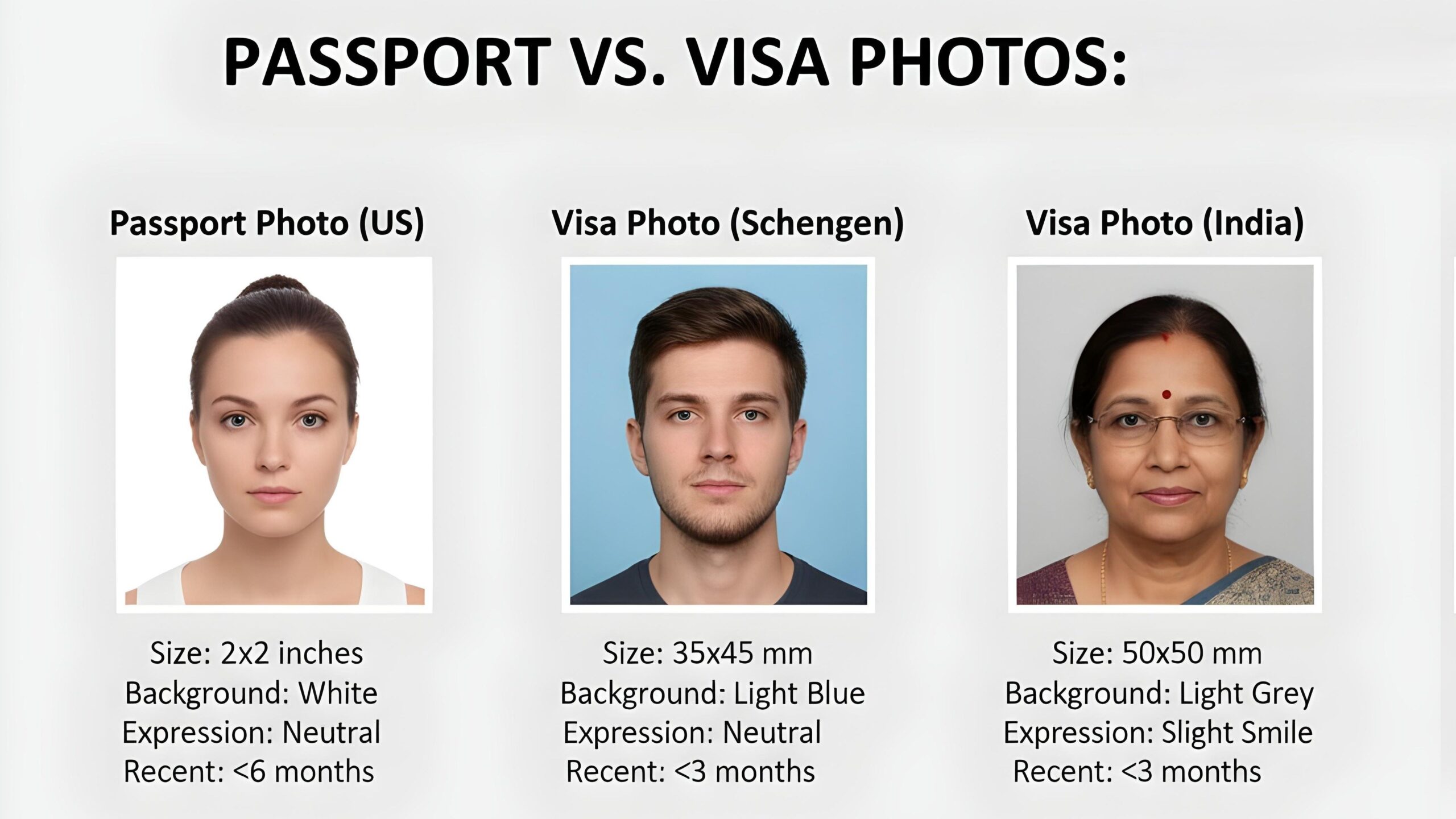
Applying for a visa can be stressful, right? Between filling out forms, paying fees, and figuring out what documents are needed, it’s easy to get overwhelmed. One question that pops up a lot is: “Can I use my passport photo for my visa?” It seems simple, but the answer isn’t always straightforward. Let’s break it down in detail.
Understanding Passport Photos vs. Visa Photos
At first glance, a passport photo and a visa photo might seem exactly the same, but subtle differences can make a big impact on your application. Both types of photos generally require a clear, frontal image of your face, a neutral expression with your mouth closed, and a plain, light-colored background. These basic guidelines are meant to ensure that your facial features are easily recognizable and consistent for identification purposes. However, even slight variations in size, composition, or background can lead to a visa application being delayed or rejected, which is why it’s important to understand the nuances before assuming your passport photo will work.
Passport photos are typically designed to meet the needs of your country’s travel identification system. This includes specific dimensions, usually 2×2 inches in many countries, a strict background color (often white or off-white), and rules about head size and placement. These specifications are standardized so that border control officers can quickly and accurately verify your identity. Visa photos, on the other hand, are meant for foreign governments, which may have slightly different requirements. This means a photo that passes for a passport might not meet the technical standards required for a visa, even if it looks nearly identical to the human eye.
Another important difference is the “recentness” requirement. Passport photos generally need to be taken within the last six months to reflect your current appearance. Some visa applications, however, may require photos taken even more recently, such as within the last three months, to ensure that the applicant’s current look is accurately represented. This can be particularly important for children, whose appearances change quickly, or for applicants who have recently undergone major changes in hairstyle, glasses, or facial hair. Using an outdated photo, even one that worked for your passport, can result in rejection.
Additionally, countries may have specific rules regarding facial expressions, glasses, headwear, and lighting that differ between passport and visa photos. For example, while most passport photos do not allow glasses, certain visa regulations may permit them as long as the eyes are clearly visible and there is no glare. Headwear for religious purposes may also be allowed in visa photos but prohibited in passport photos. Even lighting and shadow rules can vary, affecting whether a photo is accepted or rejected. Understanding these distinctions ensures that your visa application proceeds smoothly without unnecessary delays or extra costs.
Common Differences Between Passport and Visa Photos
When it comes to passport and visa photos, the differences can be subtle but important. Even a photo that looks perfect for your passport might not meet a visa application’s requirements. Here’s a detailed breakdown of the key differences:
- Size: Passport photos are usually standardized at 2×2 inches in many countries, but visa photos often have different dimensions depending on the country. For example, some European visas require 35×45 mm, while others may ask for 50×50 mm. Using the wrong size can lead to rejection, even if the image itself is fine.
- Background: Passport photos typically require a plain white or off-white background. Visa photos, however, may allow light-colored backgrounds or have specific instructions for lighting and shadow. A background that works for your passport may not always meet the visa requirements, which can lead to delays.
- Recentness: Passport photos are usually required to be taken within the last six months. Some visas, however, are stricter and may ask for photos taken within three months to ensure that the applicant’s current appearance is accurately represented. This is particularly important for children or anyone who has recently changed their hairstyle, facial hair, or glasses.
- Expression: Passport photos demand a neutral expression with a closed mouth and eyes fully open. Visa photos generally follow similar rules, but some countries allow a slight smile as long as it does not distort facial recognition. Subtle differences in expression can sometimes result in a visa photo being rejected.
- Additional Rules: Passport photos often do not allow glasses, hats, or headwear, except for religious purposes in rare cases. Visa photos may have slightly different rules. Some countries allow religious headwear as long as the face is fully visible, while others may accept certain glasses or accessories. Lighting, shadows, and even image resolution can also be more strictly enforced for visa photos.
- Head Size and Placement: In passport photos, the face is typically centered and must occupy a certain percentage of the photo frame. Visa photos may have slightly different proportions or cropping requirements, meaning a perfectly centered passport photo might need minor adjustments to meet visa standards.
- Photo Quality and Resolution: Passport photos generally focus on clarity and sharpness suitable for travel documents. Visa photos, particularly digital submissions, may require higher resolution or specific DPI settings to meet online upload standards. Low-quality scans or compressed images can lead to rejection.
When a Passport Photo Can Be Used for a Visa
| Factor | Requirement for Passport Photo | Requirement for Visa Photo | Can You Use the Passport Photo? | Notes & Examples |
| Dimensions | Usually 2×2 inches (varies by country) | Must match visa-specific dimensions (e.g., 35×45 mm for Schengen, 45×35 mm for UK) | Yes, if the size matches exactly | U.S. visas often accept 2×2 inch photos, but European visas may require cropping or resizing |
| Background | Plain white or off-white | Light-colored, plain, and free of shadows; may vary by country | Yes, if background meets embassy specs | Schengen visas require a light gray or off-white background; any shadow or pattern may cause rejection |
| Photo Age | Usually taken within 6 months | Often required within 3–6 months | Yes, if photo is recent enough | Older passport photos may be rejected for countries that require very recent images |
| Expression & Facial Visibility | Neutral expression, mouth closed, eyes open | Neutral expression (some countries allow slight smile), eyes clearly visible | Yes, if expression meets visa rules | U.S. visa allows neutral or slightly smiling expression; some countries strictly enforce closed mouth |
| Headwear & Attire | No glasses, hats, or headwear (except religious purposes) | Similar rules, but some countries allow religious headwear or prescription glasses | Yes, if allowed items comply with visa regulations | UK visa allows headwear for religious reasons as long as the face is fully visible |
Country-Specific Rules
When it comes to visa applications, one size definitely does not fit all. Each country has its own specific rules for photos, and these rules can differ significantly from the standard passport photo requirements. This is why using a passport photo without checking the visa guidelines can be risky. Even small differences in size, background color, or recentness of the photo can result in your application being delayed or rejected. Embassies and consulates take these requirements seriously because photos are critical for identity verification and security checks.
Take the Schengen Visa for Europe, for example. Most Schengen countries require a photo measuring 35×45 mm that was taken within the last six months. If your passport photo is the standard 2×2 inches, it may need to be resized or recropped to fit these exact specifications. Additionally, the background must be light-colored and uniform, with no shadows, patterns, or other distractions. Even a minor deviation in these rules can lead to rejection, which is why travelers often underestimate the importance of checking each country’s requirements carefully.
The UK visa has its own strict standards as well. It requires a photo that is precisely 45×35 mm, with the head size and position strictly regulated. Slight variations in dimensions, head tilt, or facial positioning can result in the application being refused. The UK also enforces rules regarding facial expression, lighting, and even the type of paper or digital format if you are submitting the photo online. This illustrates that what works for a passport in your home country might not automatically meet another country’s visa standards.
Meanwhile, some countries are more flexible. Canada, for instance, may accept a passport photo if it meets the required size and background standards. However, even in such cases, embassies often advise that the photo be recent, high-quality, and free of shadows or glare. Checking the official visa website is essential because relying solely on a passport photo can lead to surprises. Each country’s guidelines are updated periodically, and verifying these rules before submitting your application ensures that your photo will not be a reason for delays or rejection.
Key Things to Check Before Using a Passport Photo
Before submitting a passport photo for a visa, it’s crucial to double-check every detail. Even small mistakes can result in delays or rejection, so attention to detail is your best friend. Here’s a comprehensive list of factors to verify:
- Dimensions and Size: Ensure the photo dimensions match the exact visa requirement. Some countries accept 2×2 inches, others require 35×45 mm or 45×35 mm. Even a tiny deviation in size can lead to automatic rejection. If your passport photo differs, you may need to resize or recrop it professionally.
- Background Color and Quality: Check that the background color meets the visa specifications. Most visas require a plain, light-colored background with no patterns, shadows, or gradients. A background that works for your passport photo may be slightly off for a specific visa, so make sure it’s uniform and well-lit.
- Photo Age and Recentness: Many visas require photos taken within the last 3–6 months to reflect your current appearance. Using an outdated passport photo, even one that looks fine, can lead to rejection. This is particularly important for children or anyone who has recently changed hairstyles, glasses, or facial features.
- Head Position and Facial Expression: Your head must be centered, facing forward, with a neutral expression. Eyes should be open and clearly visible, and the mouth closed unless the specific visa allows a slight smile. Even slight tilts or unnatural expressions can cause problems, so review the embassy guidelines carefully.
- Glasses and Headwear: Check if glasses, hats, or religious headwear are allowed. Many passport photos prohibit glasses due to glare, but some visa photos permit prescription glasses if eyes are clearly visible. Head coverings for religious purposes are allowed in some visas but strictly prohibited in others.
- Lighting and Shadows: Ensure the photo is evenly lit with no harsh shadows on the face or background. Poor lighting can obscure features and lead to automatic rejection. Make sure there are no shadows caused by hair, glasses, or headwear.
- Photo Quality and Resolution: The image should be sharp, clear, and high-resolution. Blurry, pixelated, or overexposed photos are often rejected. For digital submissions, check the required resolution and file size, as some countries have strict online upload rules.
- Proportions and Head Size: Verify that the head occupies the correct percentage of the photo frame as specified by the visa guidelines. A head that is too small or too large can result in the application being returned.
- Orientation and Cropping: The photo must be properly oriented (portrait) and cropped according to embassy rules. Misaligned or poorly cropped photos can be rejected, even if all other criteria are met.
Common Mistakes to Avoid
| Mistake | Description | Why It Causes Issues | How to Avoid It | Example |
| Old Passport Photo | Using a photo older than 6 months | Your appearance may not match current features | Always take a recent photo that meets visa guidelines | A passport photo taken a year ago may be rejected for a Schengen visa |
| Incorrect Size or Aspect Ratio | Photo dimensions do not match visa requirements | Slight variations can lead to automatic rejection | Check embassy size specifications and crop or resize if needed | Using a 2×2 inch passport photo for a UK visa requiring 45×35 mm |
| Background Issues | Background is patterned, colored, or has shadows | Non-uniform backgrounds can interfere with facial recognition | Use a plain, light-colored background with even lighting | A grayish or shadowed background may be rejected by the US embassy |
| Unauthorized Glasses or Headwear | Wearing glasses, hats, or accessories not allowed | Reflective glare or obscured features can cause rejection | Remove glasses unless allowed; only wear headwear for religious purposes | Wearing sunglasses or a baseball cap in the photo |
| Exaggerated Facial Expressions | Smiling too broadly, frowning, or making faces | Facial recognition systems require a neutral expression | Maintain a neutral expression with mouth closed and eyes open | A wide smile or raised eyebrows may lead to visa photo rejection |
Tips for Getting the Perfect Visa Photo
Think of your visa photo as the first impression of your application—it’s the first thing embassy officials see, and even small mistakes can cause delays or rejection. One of the most important steps is to go professional whenever possible. While passport photo booths are convenient, they often don’t meet the exact specifications required by different countries. Professional photographers are usually familiar with visa-specific requirements, such as precise dimensions, lighting standards, and acceptable head positions. Investing in a professional photo may cost a little more, but it can save you significant time, money, and stress in the long run.
Another crucial step is to check embassy guidelines carefully before taking or submitting a photo. Many embassies provide detailed instructions on their websites, including sample images showing acceptable head positions, background color, and expression. These resources are invaluable for ensuring your photo meets all official requirements. Skipping this step and assuming your passport photo is sufficient can lead to rejection, which is especially frustrating if you have already paid visa fees and scheduled an appointment.
It is also essential to avoid any digital alterations or enhancements. Embassies want an accurate, unaltered representation of your appearance. Filters, retouching, or even minor edits can cause your photo to be rejected, as these changes may interfere with facial recognition or verification processes. Your photo should reflect your natural appearance with no modifications to facial features, skin tone, or lighting. Submitting an altered photo can lead to unnecessary delays, extra fees, and even questioning at the embassy.
Finally, always take multiple shots to ensure at least one photo is perfect. Even in professional studios, slight changes in expression, lighting, or angle can make a difference. Having several options allows you to select the one that meets all specifications exactly. Taking multiple shots also helps you feel confident that your application is complete and reduces the likelihood of having to retake a photo after submission. This simple step can make the visa application process much smoother and less stressful.